
1
The hands take weight first. Monkey bars, the climbing wall, hanging and pushing across the 2,100 square foot gym. Hands that can hold up a whole body can hold a pencil.
Your kid walks out able to do the small things without you: the zipper, the buttons, the fork, the scissors that always went sideways. Grip, in-hand control and two hands working together, ages 2 to 16.
What It Is
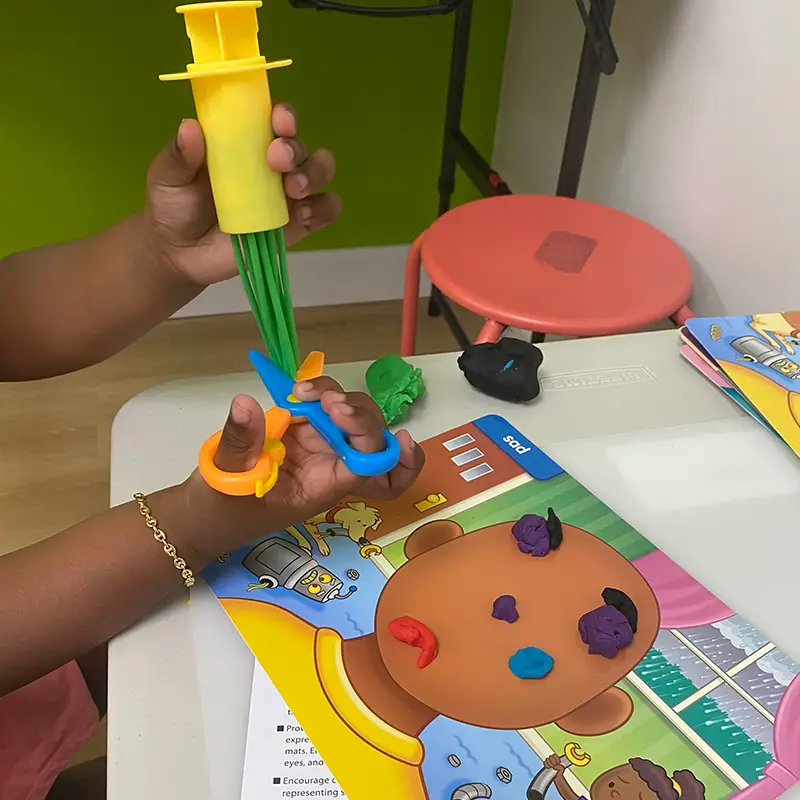 Strength first, then precision
Three quiet skills run your child’s hands. Grip, or how much strength the fingers can hold. In-hand manipulation, or shifting a coin from palm to fingertips without help from the other hand. Bilateral coordination, where one hand steadies while the other works. Every button, zipper, fork and pair of scissors sits on those three.
So we build them in that order. Strength before precision, one-on-one with a licensed occupational and physical therapist, on goals set at the comprehensive initial evaluation. The 2,100 square foot gym does the heavy part, then the table work turns it into the real task on the real coat.
You do the buttons in the hallway because the bus is coming. You cut the food at the table without thinking about it anymore. That was never coddling, that was a morning that had to happen on time. Somebody just has to build the skill at an hour that is not 7:40am.
What It Helps
Fine motor demand climbs every single grade while the hand stays the same size. A kid fighting the pencil spends the effort on the pencil instead of on the idea they were trying to write down. Hands are trainable, and this is what training them looks like.
What A Session Looks Like
1
The hands take weight first. Monkey bars, the climbing wall, hanging and pushing across the 2,100 square foot gym. Hands that can hold up a whole body can hold a pencil.
2
Then small and precise at the table: putty, tongs, beads, coins, scissors. Every one of them is a game, and every one of them is aimed at one part of the grip.
3
We finish on the real thing: the button on the real coat, the zipper on the real backpack. You watched it live on the waiting room screen, and we debrief with the one task to hand back at home.
What Changes
Dressed and zipped while you pour the coffee.
The lunch container opens without a teacher.
The fork wins out over the fingers.
The cutting project gets finished, not abandoned.
Pairs Well With
Questions, Answered
You do not have to make that call on your own, and that is what the comprehensive initial evaluation is for. What parents usually bring us is a pattern: the buttons that never got easier, the fist grip on the pencil, the fork that keeps getting abandoned, the coat that still needs you every morning. We measure it, then tell you plainly whether it needs work or time.
Practice helps once the hand has what the task needs. Before that, repetition just makes the workaround stronger, which is how a hammer grip becomes permanent. We build the strength and the control first, then hand the practice back to you with the right task and the right setup. You leave every session with one thing to do at home.
We work with ages 2 to 16, and older kids are absolutely worth working with. A grip is a habit built on whatever strength and control were available at the time, so the honest answer depends on what the evaluation finds. Sometimes we change the grip. Sometimes we build endurance around the one your child already has, because the goal is a hand that lasts through the assignment.
We are an out-of-network provider and we submit claims on your behalf when your plan has out-of-network benefits. Self-pay is $360 for the comprehensive initial evaluation, then $90 for 30 minutes, $135 for 45 minutes, $180 for 60 minutes, with 10% off an 8-session package and 15% off a 12-session package. We accept credit cards, cash, checks, FSA and HSA. Call (516) 744-7550 and we will walk the numbers with you before you commit to anything.
This is a plan with an endpoint, not an open subscription. Progress is reassessed regularly, and discharge planning starts once your child is meeting goals with at least 80% accuracy. Then you get a home program for maintenance and carryover, because a skill that only shows up in the therapy room is not finished.
Book Your Visit
Tell us what you’re noticing at home. A real person calls you back to set up the comprehensive evaluation. No phone tree. No ‘someone will reach out.’
5.0 · 28 Google reviews
Ages 2 to 16, individual and group
Step 1 of 5
That’s the hard part done. We’ll call during business hours to set up the evaluation and answer whatever you didn’t get to ask.
Visit Us