What We Treat

Fine motor delays: the buttons win every morning.

The coat still half on when everyone else is already outside. The fork abandoned for a fist. Small hands need the right practice in the right order, not more reminders. It starts with a comprehensive evaluation, one-on-one with a licensed occupational and physical therapist.

Ages 2 to 16 Play-based sessions Watch every session live Talk to a Specialist

Sound Familiar?

Does this sound like your mornings?

  • The coat is still half on when every other kid is already outside
  • Buttons and zippers quietly became your job, and you both stopped mentioning it
  • The fork gets put down halfway through dinner and the fingers take over
  • Scissors sit in the wrong fingers, and the line never really gets followed
  • The lunchbox comes home full because he could not get the container open
  • The pencil is held in a fist, and the hand is worn out after four words

Recognize two or more? That is worth a proper look.

Why It Happens

It isn’t carelessness. The floor underneath is missing.

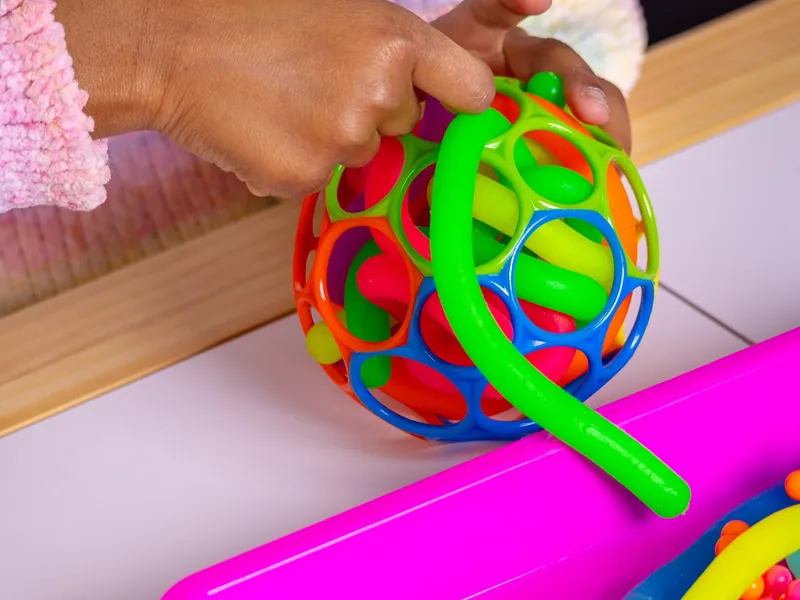
Close-up of a young child’s hands gripping a brightly colored open-frame plastic ball and a bendy green tube on a table

Fine motor skill means the fingers doing small, precise, separated work, and almost none of it starts in the fingers. It starts at the shoulder and the trunk. A hand can only be accurate if the arm behind it is steady, and the arm is only steady if the middle of the body is. Then the hand has to learn to split its jobs: thumb, index and middle finger do the moving while the last two fingers hold the base still. Some kids pick that up from climbing and carrying and messing about. Some kids have to be taught it.

There is a second half, and it is feeling. To do a button without looking, your kid has to sense how hard to squeeze and where the fingers are. When that feedback is fuzzy, the hand grips too tight, tires early and quits, which is why “try harder” and “practice more” so rarely change anything. A comprehensive initial evaluation sorts out which layer is short, the strength, the stability, the finger separation, or the feel, and the plan starts at that layer instead of the worksheet.

The Honest Truth

Hands get better with reps. Not with time.

If you keep waiting

  • He gets faster at dodging the task instead of better at the task
  • Somebody kind keeps doing the buttons for him, and the practice quietly disappears
  • Cutting sits under writing and writing sits under everything, so a year of waiting is a year the gap widens while he works harder than his class for the same worksheet

If you start now

  • You find out whether it is the strength, the stability, the finger separation or the feel
  • He builds it on monkey bars and a climbing wall first, then in the fingers, in that order
  • You get a plan with an endpoint, and a home program that fits on your kitchen table

Nobody handed you a checklist. You just noticed that helping with the coat had turned into doing the coat. The parents who act on that quiet little observation are the ones whose kids get the practice back.

How It Works

The same four phases. Built around a pair of small hands.

Every plan has an endpoint. Here’s what the four phases look like when the hard part is the buttons.

Starts at the evaluation

Pinpoint

Take the fight out of the routine.

What hurts is the morning: the buttons, the coat, the lunchbox that came home unopened. The comprehensive evaluation tells us why the hand is struggling, so we stop drilling the thing that was never the problem.

The early weeks

Prime

Build the arm before the fingers.

Core, shoulder and hand strength on the monkey bars and the climbing wall. A hand cannot be precise while the arm behind it is still busy holding itself up.

As the skills come online

Perform

Do the actual task.

Buttons, zippers, scissors, cutlery, the pencil. Here first, then at your kitchen table and in the classroom, until it happens without anybody hovering.

Carryover and discharge

Prevent

Hand it back to your family.

You get a home program and we collaborate directly with his school. Discharge planning starts once goals are being met with at least 80% accuracy, so there is a real finish line to walk toward.

Unlike other OT places planet sensory has lot of equipments that are really beneficial for kids. I been to many kids OT/PT places, never seen a big sensory play area like planet sensory. I see a lot of improvement in my son’s fine motor skills.

Sebin R.

Before: many kids OT/PT places, never a big sensory play area

After: a lot of improvement in his fine motor skills

Google review 5 stars

Questions, Answered

What parents ask before they book.

Plenty of kids arrive at a skill late and are completely fine. The useful question is not when, it is whether the foundation underneath is there: shoulder and core stability, hand strength, and the ability to feel what the fingers are doing. If those are in place, time usually does the rest. If one of them is missing, time mostly buys more practice at the wrong thing. A comprehensive initial evaluation answers that in one visit instead of another school year.

Worksheets test a skill. They rarely build one. If the shoulder is unstable or the fingers cannot separate their jobs yet, more repetitions on paper mostly add frustration and teach a workaround that is harder to undo later. We work the layer that is actually short, usually strength and stability first, then the hand, then the real task. After that you get a home program designed to fit a normal evening, not to become a second round of homework.

It looks like play, and that is on purpose. Fine motor work happens through climbing, pulling, building, cutting and games in a 2,100 square foot sensory gym, because a kid who is enjoying herself gets many times the repetitions of a kid being made to sit and practice. The goals underneath are specific and they are measured. You just will not hear them called that, and you can watch the whole thing on the live feed from the waiting area.

School services exist to help a child access their education, and they are often delivered in a group. Here your daughter is one-on-one with a licensed occupational and physical therapist, working on goals that include the ones that live at home: the coat, the cutlery, the lunchbox nobody at school sees. We collaborate directly with her school, so the two are complementary rather than a repeat of one another.

We are an out-of-network provider, and we submit claims on your behalf when your plan has out-of-network benefits. Self-pay rates are $360 for the comprehensive initial evaluation, then $90 for 30 minutes, $135 for 45 minutes, and $180 for 60 minutes. An 8-session package is 10% off and a 12-session package is 15% off. We accept credit cards, cash, checks, FSA and HSA, and if benefits run out, care continues on private pay with a payment plan.

Book Your Visit

Ready when you are.

Tell us what you’re noticing at home. A real person calls you back to set up the comprehensive evaluation. No phone tree. No ‘someone will reach out.’

  • Hours Mon–Thu 1:00pm–7:00pm · Fri 10:00am–7:00pm · Sat 9:00am–2:30pm · Sun Closed
  • (516) 744-7550 Prefer to just talk it through? Call us.
  • Saturday appointments, 9:00am to 2:30pm

5.0 · 28 Google reviews

Ages 2 to 16, individual and group

Step 1 of 5

So we know who to look for when you and your child walk in.

Visit Us

Right on Merrick Road, in Baldwin.

Planet Sensory