
1
We start by moving the engine on purpose in the 2,100 square foot gym. The zipline and the crash pads take it up. A slow swing, a climb, deep pressure take it back down. Your kid feels the difference in their own body.
Your kid walks out with something to do besides fall apart: a way to catch the body winding up, and a move that brings it back down. Practiced one-on-one, ages 2 to 16, in a 2,100 square foot gym.
What It Is
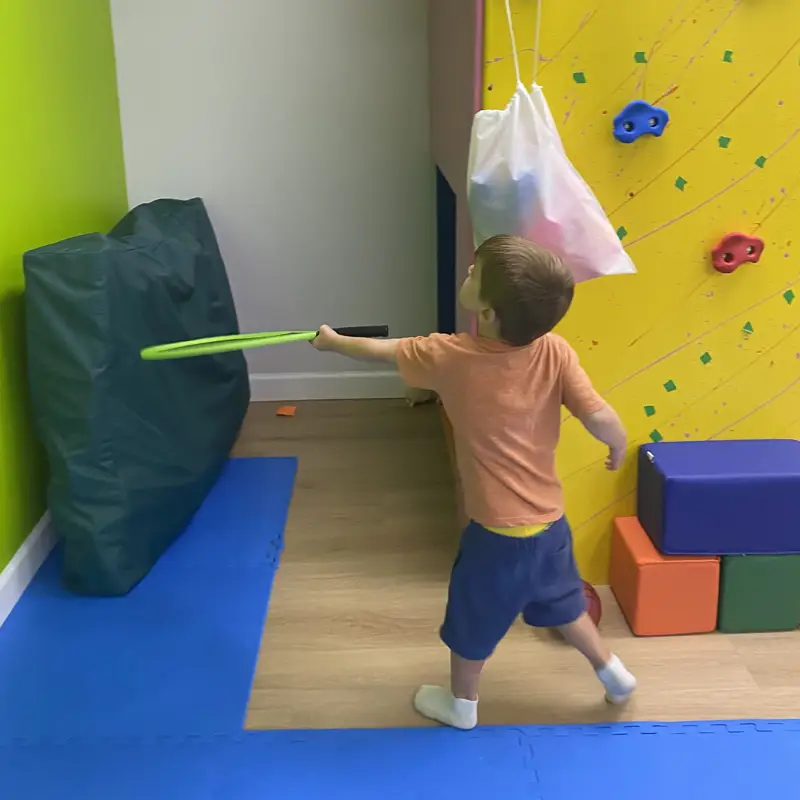 Practiced under real pressure, on purpose
Self-regulation is one skill with two halves: noticing what your own body is doing, and knowing a move that changes it. Most kids absorb it by watching. Some do not, and no amount of reminding installs it, because you cannot remind a child into a skill they were never taught.
So we teach it as a skill. Naming the early signals, the hot face, the loud voice, the buzzing hands. Building a short menu of things that actually bring the engine down. Then rehearsing transitions, waiting, and losing the game, one-on-one with a licensed occupational and physical therapist, on goals set at the comprehensive initial evaluation.
You have taken advice from people who watched your kid for four minutes. Be firmer. Be softer. He is testing you. None of that was true, and holding your ground through it was the harder job. The parents who get here fastest are the ones who stopped waiting to be believed.
What It Helps
Every school year adds more transitions, more waiting, more losing in front of an audience. Skills not built now get built later, under far more pressure and with more people watching. Built early, they stop being strategies and just become how your kid handles things.
What A Session Looks Like
1
We start by moving the engine on purpose in the 2,100 square foot gym. The zipline and the crash pads take it up. A slow swing, a climb, deep pressure take it back down. Your kid feels the difference in their own body.
2
Then we make it hard on purpose. The timer ends the favorite game. The tower falls. Your kid names what the body is doing and picks a move, with help first, then with less.
3
You watched every minute of it live on the waiting room television, so the words used in here are the words used at home. We debrief after each session and pick the one to use this week.
What Changes
Transitions stop costing the whole evening.
Losing the game stays a game.
He tells you he is done before he is done.
The strategy works at school without you there.
Pairs Well With
Questions, Answered
No. A behavior program is built around compliance, and it assumes the skill is already there and simply is not being used. We assume the opposite: that the noticing and the calming down are skills your child has not been taught yet. So we teach them, practice them under real pressure, and hand them to you and the school to keep using.
Because holding it together all day costs something, and home is where it finally gets spent. It also means the teacher genuinely may not see what you see, which is why so many parents get told everything is fine. Regulation that only works when someone is watching is not finished yet, and that is exactly what this service builds out.
Usually not. In New York, pediatric occupational therapists can evaluate and treat without a physician referral for up to 30 days, and that applies to non-restorative services such as handwriting, learning and developmental skill training when your child is not in acute care. If your plan wants a referral on file, tell us and we will walk you through it.
We are an out-of-network provider and we submit claims on your behalf when your plan has out-of-network benefits. Self-pay is $360 for the comprehensive initial evaluation, then $90 for 30 minutes, $135 for 45 minutes, $180 for 60 minutes. Packages take 10% off at 8 sessions and 15% off at 12. Credit cards, cash, checks, FSA and HSA are accepted, and if benefits run out, care continues on private pay with a payment plan. Call (516) 744-7550 to run your numbers.
You will see it three ways. Live, on the waiting room feed, when your kid recovers from something that would have ended the session a month ago. In the debrief after every visit. And in the reassessments, where discharge planning starts once goals are being met with at least 80% accuracy, followed by a home program so it carries over.
Book Your Visit
Tell us what you’re noticing at home. A real person calls you back to set up the comprehensive evaluation. No phone tree. No ‘someone will reach out.’
5.0 · 28 Google reviews
Ages 2 to 16, individual and group
Step 1 of 5
That’s the hard part done. We’ll call during business hours to set up the evaluation and answer whatever you didn’t get to ask.
Visit Us